








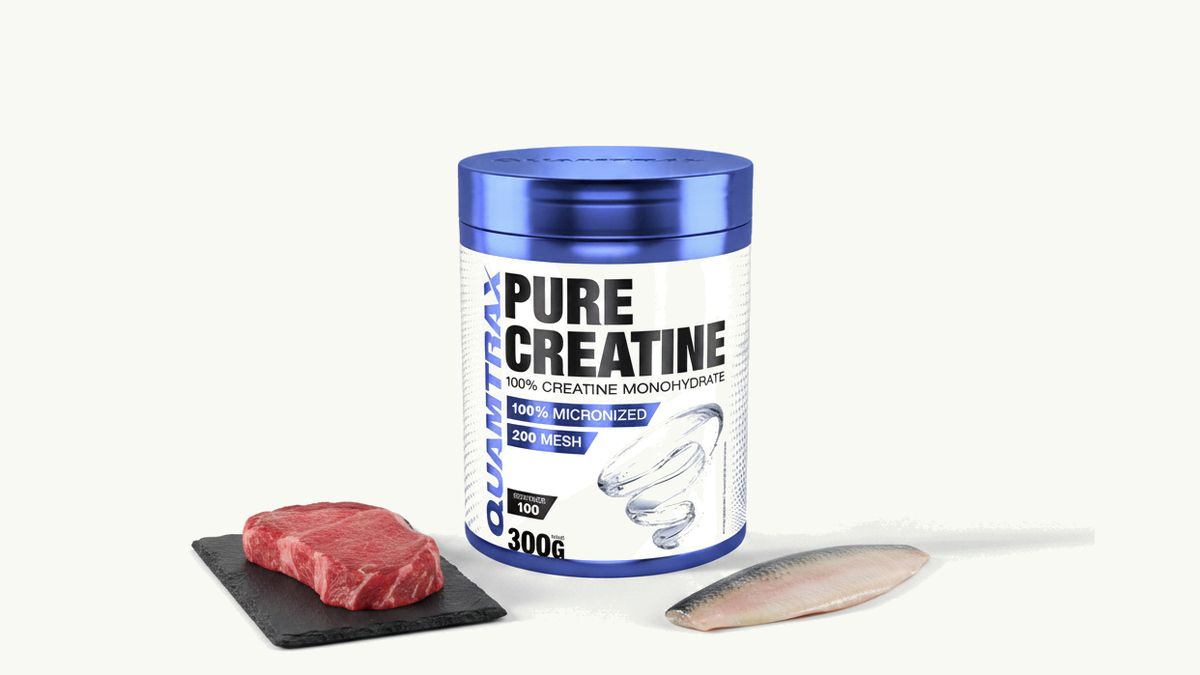
Creatine is naturally found mainly in meat and fish. Herring and red meat contain the most, plant-based foods virtually none. In addition, your body produces about one gram itself every day. To reach the 3 grams per day linked to the approved creatine claim, food portions alone are quite substantial; that is why many athletes opt for a supplement. Below you will find exactly where creatine is found and when a scoop of powder is the more practical route.
Which foods contain creatine?
Mainly in muscle tissue, so in meat and fish. Herring is the top performer, beef and pork are in the middle range, chicken slightly below. Dairy products and eggs contain at most traces, and vegetables, fruit, grains and legumes provide virtually nothing. Logical: creatine is a substance stored in muscles.
| Source | Creatine (indicative value per kilo of raw product) |
|---|---|
| Herring | ± 6 to 10 grams |
| Pork | ± 5 grams |
| Beef | ± 4.5 grams |
| Salmon | ± 4.5 grams |
| Tuna | ± 4 grams |
| Chicken | ± 3 to 4 grams |
| Cod | ± 3 grams |
| Dairy products and eggs | Traces |
| Vegetables, fruit, grains, legumes | Virtually none |
These are indicative values per kilo of raw product; a normal portion of 100 to 150 grams therefore yields roughly half a gram. Boiling, frying or grilling also causes some losses. Anyone wanting to get all their creatine from food alone would need to eat quite large quantities every day.
On paper, a generous portion of herring per day gets you a long way. In practice, nobody keeps that up, and fortunately that is not necessary. You choose your food based on taste, protein content and variety; for creatine itself, there is a simpler solution than eating the same fish every day.
How much creatine does your body produce itself?
About one gram per day. Your liver and kidneys build creatine from amino acids, the building blocks of protein. Combined with what you get through your diet, your body keeps the supply in your muscles at a baseline level. You therefore never start at zero.
That baseline level is not the same as a saturated store, however. The approved EFSA claim – creatine increases physical performance during successive bursts of short-term, high-intensity exercise – applies at a daily intake of 3 grams. You will not reach that with your own production plus an average diet. You can read what a saturated store actually does in what creatine does.
Why is a supplement often more practical?
Simple maths. For 3 grams of creatine from food, you need in the region of half a kilo to a kilo of meat or fish, every single day. One level scoop of monohydrate in a glass of water achieves the same thing in ten seconds, even on days when herring happens not to be on the menu.
This is not an argument to replace your dinner with tubs; food provides much more than creatine alone, and a supplement remains an addition to a healthy, varied diet. It is simply the straightforward observation that a supplement here does exactly what it is designed to do: supplement what is not practically achievable through your ordinary eating pattern. A basic monohydrate such as ESN Ultrapure Creatine is enough for that; bells and whistles add nothing.
What about vegetarians and vegans?
Anyone who does not eat meat or fish gets virtually no creatine from food and relies entirely on their own production of about one gram per day. For your health this is not a problem; your body manages its baseline supply on its own. But the 3 grams from the claim are then by definition not achievable through diet alone.
For vegetarian and vegan athletes, a supplement is therefore the logical route to those daily 3 grams. Good to know: creatine monohydrate in supplements is produced synthetically and does not come from animals. If you use capsules instead of powder, do check the label; the capsule itself may contain gelatine.
Food or supplement: how do you choose?
If you eat plenty of meat or fish daily and train recreationally, your baseline is fairly well covered. If you want to consistently hit the 3 grams per day associated with the claim, a supplement is the reliable route. The two are not mutually exclusive.
If you choose a supplement, keep it simple: a fixed daily dose at a time that is easy to maintain, including on rest days. No loading phases or complicated protocols needed. How to pick that fixed moment and what to do if you miss a day, you can read in when to take creatine.
Frequently asked questions about creatine in food
Is there creatine in eggs or dairy products?
At most traces. Creatine is stored in muscle tissue, and eggs and dairy products are not muscle tissue. They are excellent products for your protein intake, but as a creatine source they are negligible. Meat and fish are the only meaningful sources in everyday food.
Is creatine lost during cooking?
Partly, yes. When heated, some of the creatine in meat and fish is broken down or lost in the cooking liquid. The indicative values per kilo of raw product therefore always turn out somewhat lower on your plate. Yet another reason why the calculation often points towards a supplement.
Is creatine in supplements made from meat?
No. Creatine monohydrate is produced synthetically and contains no animal raw materials. Powder variants are therefore almost always suitable for vegetarians and vegans. If you use capsules, check the label: the capsule itself may contain gelatine.
Do you notice a difference between creatine from food and from a supplement?
No. Creatine is creatine; your muscles make no distinction between a molecule from a herring and a molecule from a tub. The difference lies purely in practicality: with a supplement you reliably reach 3 grams per day, with food alone it becomes a full-time task.
How much creatine do you need per day?
The approved claim applies at a daily intake of 3 grams; in practice many athletes maintain 3 to 5 grams. Follow the label of your product and take your dose every day, including days when you are not training.
In short: creatine comes from meat and fish, but anyone aiming for a consistent 3 grams per day will find a scoop of monohydrate faster and more reliable. Food first, supplement where it is practical.